

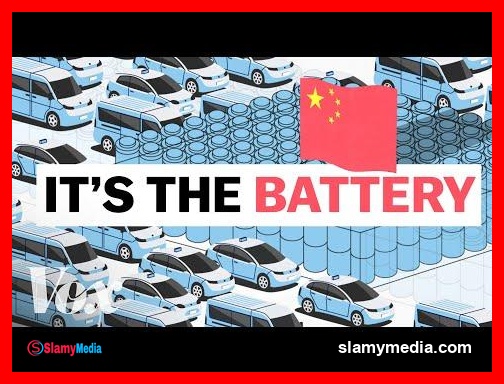
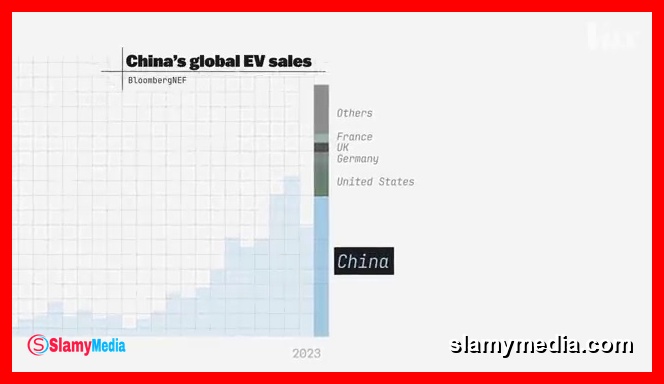
years, they brought slick and affordable electric cars to the market. Key to this rise is the electric vehicle battery. This part of the EV is where China has really come to dominate the global market. So how did Chinese companies create the world's leading EV battery? And can US automakers make an affordable electric car without it? The first major reason for why China's companies were able to develop their EV battery is due to a huge amount of government support. Roughly 20 years ago, China was on track to become the world's largest importer of oil, so electrifying its car fleet would help it become more energy independent. Not to mention a growing air pollution problem in China's cities and part due to car emissions. What the EVs had going for them was that the head of the Ministry of Science and Technology was a big believer in this. And his sense was that Chinese companies were just never going to be able to compete on internal combustion and engine technology. That's how you get this package of policies that really supported what Chinese government defined as new energy vehicles. Companies making the cars can get us up to whenever they sell a car. We're also talking about they're getting cheap, like land leases from the government. They're getting cheap loans from the state-owned banks. According to one estimate, from 2009 to 2022,
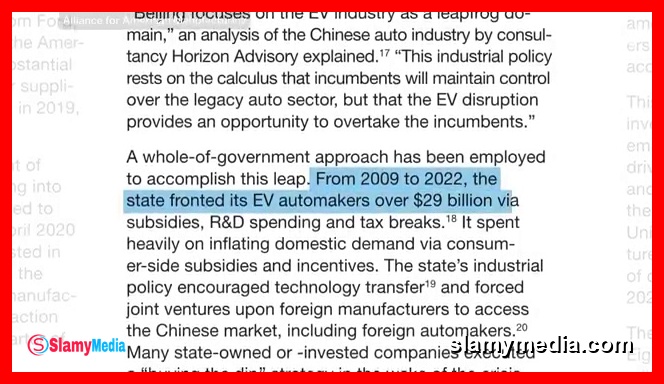
the Chinese government gave out $29 billion in the form of subsidies, research spending, and tax breaks to the EV industry. And starting around 2009, local governments also gave Chinese companies an instant market by contracting them to electrify their bus and taxi fleets. The city of Shenzhen's fleet of 16,000 buses was electrified by BYD before it became the world's largest EV company. To get consumers on board, governments offered them generous subsidies too, along with other benefits. Like discounts on charging, favorable parking, traffic congestion-related policies that EVs get a break on. EVs actually have a different colored license plate even, so it's very visible. And some people say, oh, that's an EV. They get all the special treatment. But the battery wasn't very good in the early days. And so the Chinese government goes in and starts introducing stricter standards on batteries, saying, well, you only qualify for discredit if your battery density reaches this level. Consumer EV sales in China exploded. And when it did, the government did something important to protect their own battery industry. When foreign car companies like GM and Tesla wanted to sell their EVs in China, the government made a rule that their cars must use Chinese made batteries to qualify for consumer subsidies. China's central government phased out consumer subsidies in 2022. But the demand had been created. In 2024, over half of new car sales in China were electric. This is like a milestone because half

is a big thing, instead the majority of the people are actually preferring EVs over gas car stall. The second way Chinese battery companies became so dominant is through the supply chain for the battery components. The type of battery that typically goes into electric vehicles is called a lithium ion battery. The forming components of the battery cell are the cathode, the anode, the electrolyte solution, and a separator. The cathode is usually packed with nickel, cobalt, and mang knees. The anode uses graphite and the electrolyte is made up of mostly lithium salts. Over the past several years, Chinese companies started acquiring ownership stakes in mines around the world where these minerals exist. The effect is that Chinese companies control significant percentages of the world supply of the minerals needed for batteries. But where China really controls the supply chain are the steps after mining. No matter who mines the minerals, China refines a vast majority of them. This is the step where factories grind down raw materials and extract the desired mineral from it. It's pretty polluting. That's why you don't see as much refining happening in developed countries. Chinese plants then also manufactured the vast majority of the four components of the EV batteries, the cathode, the anode, the electrolyte, and the separator, and put them together to make the battery cell. Because you already had pretty developed manufacturing for batteries aimed at electronics. So BID is actually one of those

examples. They started by producing batteries for electronics in the 90s, and then it got into producing EVs. The US was never a battery manufacturing player. Historically speaking, in Lithium Ion, it was previously Japan and Korea. China has now superseded both. China's control of the battery supply chain is so encompassing that after the Biden administration passed a rule saying no more than half of the battery's components or minerals could be Chinese source to qualify for tax credits, only an estimated 20% of EV models qualified. With their market dominance, Chinese companies have been able to lead the world in battery innovation. In the past two years, Chinese companies figured out how to avoid using the two most expensive battery minerals, nickel and cobalt. They did this by innovating on battery technology called Lithium Iron Fossfit or LFP. In 2023, CETL announced an LFP battery that could power a car for 370 miles on just a 10-minute charge. MPYD has developed their own version of an LFP battery too. It's called Blade Battery. It's like very, very long blade, but basically they're saying that by using that shape, it can train more batteries into the same space. So in that way, like, the same size of a car can travel farther. Today, LFP batteries are a growing share of all EV batteries, and nearly all of them are manufactured in China. But not for

long, CETL has built battery plants in Germany and has plans to build one in Hungary for the European auto market. And Ford ended up finding a home for its CETL battery plant in the town of Marshall, Michigan. The project has triggered a US house investigation, but if it goes through, it'll be the first LFP plant in the US. All of these factors have made Chinese EV batteries virtually impossible to avoid in the global transition to electric vehicles. Was there not a viable alternative? No, there wasn't. LFP technology is very well developed. The battery business is a global business, and this was, there were no alternatives. There are some concerns about whether China's government support of the EV industry amounts to unfair global competition, as well as human rights and environmental concerns associated with China's battery supply chain. The US is investing their own government support to build up its battery industry. Bloomberg estimated it would cost $82 billion for the US to meet their own domestic demand by 2030. So it might be possible in the future, but that's no help right now when we desperately need to transition to electric vehicles to wean ourselves from fossil fuels. And US automakers are struggling to give consumers affordable options. So for now, we'll have to decide whether our desire to keep our distance from China outweighs our goals of going electric.
Conversations (0)