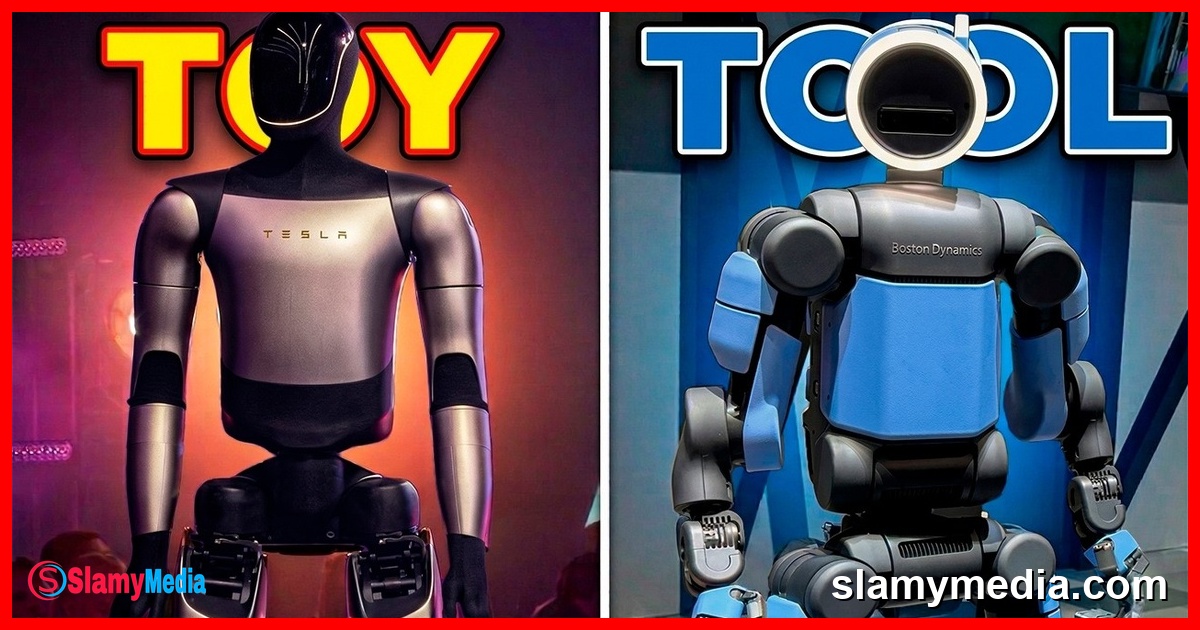
Take a look at the new Atlas robot. Now look at these sleek beauties. Which one do you like better? Honestly, it doesn't even matter because 10 years from now all humanoids are going to look like this. Or maybe even weirder. It's not about aesthetics, it's about the only way to actually survive in the real world. And by the way, this ugly robot was designed by a man who spent 12 years creating the most elegant designs at Apple. So how did that happen? Well, it's simple. The race to build the prettiest robot, with the smoothest skin, the most graceful hands, and the most human-like gate is going nowhere. Those robots are going to stay prototypes, and only the cheapest ones will ever land jobs as tour guides or receptionists. Meanwhile, Atlas, with its weird limbs, cooling fins, and joints that make it look like part insect, part reptile, will be rolling off the Hyundai assembly lines by the thousands and selling like hot cakes. Why does this robot look so strange? And why is it actually a stroke of genius? How did Boston Dynamics manage to solve problems their competitors haven't even realized exist yet? The company recently broke its silence and revealed everything during a tech talk. We've analyzed an in-depth conversation between three key people to tell you exactly why Atlas is such a unique project. One of them spent 15 years building these robots. Another spent 25 years turning complex concepts into commercial products. And the third spent 12 years at Apple, leading product development for the entire Mac Division. Yeah, James Cusio spent years cramming massive computing power into compact Mac chassis and making sure products worked perfectly right out of the box. And now, even he admits he's never built anything more complex than Atlas's head. This is a story about a fundamental disagreement in robotics. Is the human form actually ideal for our world? The answer to that question changes everything. Specifically, it decides who wins the humanoid robot race. In our last video, we broke down how Hyundai solved the business puzzle of humanoid robots, but we didn't really look under the hood. Today, we're fixing that. Let's start with the most obvious thing, the legs. If you put Atlas next to any other humanoid, optimist, figure, unitary, the legs are the first thing that look off. They're wider than you'd expect. There's an offset between the upper and lower sections that makes them look almost like insect legs. When the robot was first unveiled, a lot of people were convinced it was just an early design compromise, but it wasn't. I think the legs were the biggest concern, because they're an obvious departure from a human form. And that's what everybody is expecting to see. Let's look at this from an engineering perspective. When your need bends, it creates a gap in the joint. This same issue haunts robot joints. Why is that a problem? Because with the sheer power of modern actuators, anything that gets caught in that gap is going to be crushed or snapped.
Scene 1 from Why Atlas Will Outwork Every Other Humanoid (Tesla Included)
Or it might just break the robot's joint itself. It's a massive problem and a serious safety risk for humans working alongside the robot. Boston Dynamics decided to tackle this head-on with a strict rule, a minimum one-inch clearance in every single joint, through the entire range of motion in every possible position. That might not sound like a big deal until you realize what it actually takes. To maintain that gap everywhere, the engineers had to rethink the entire design. And yeah, that shifted the segments of the limbs, made the legs wider and made the robot taller. All the proportions changed. If you need to accommodate a one-inch gap, that's going to immediately impact the height of the robot. But if engineers are so obsessed with optimization, why not just simplify the form and get rid of some of those joints altogether? You could do that, for example, by putting the robot on wheels. That's exactly what the Swiss giant hexagon did. Their eon robot has been zipping around the floors of the BMW Plant in Leipzig since December 2025, hauling cargo. Wheels allow for faster movement and use way less energy. But that only works on a flat floor and only for delivery tasks. The engineers at Boston Dynamics decided right off the bat that they didn't want an electric scooter with arms. They were building a universal robot, and they calculated that a wheeled base is actually heavier and uses more energy if the robot needs to, say, reach up and grab a heavy part off a high shelf. For atlas, feet aren't a luxury. They're the only way to maintain high performance in any environment. But the shape of the legs is just the visible part. The real magic is hidden inside. The company's engineers didn't just rethink how the robot looks. They rethought what actually drives it. The trick is that the entire robot runs on just two types of motors. Just two. Most humanoid robots use unique actuators for every single joint. The hip, knee, shoulder, elbow, wrist. They all have their own specific drive. Some companies buy off the shelf parts. Others custom design an actuator for every single joint. That's slow, it's expensive, and it's unreliable. Can you imagine how many stress tests you'd have to run on all those different sized actuators just to make sure the robot works reliably in the real world? Atlas takes a completely different approach. But when you have a really compact, you know, power dense actuator, you can now put the same one that you have in the hip as you can in the ankle, and you unlock all this modularity and simplicity in the robot that you just couldn't get any other way. So see the logic? The engineers designed and stress tested just two actuators and distributed them across the entire robot, 10 of one type, 13 of the other, and that's the whole robot. It sounds so simple and logical, right? But is it actually? Because the actuators themselves are anything but ordinary.
Scene 2 from Why Atlas Will Outwork Every Other Humanoid (Tesla Included)
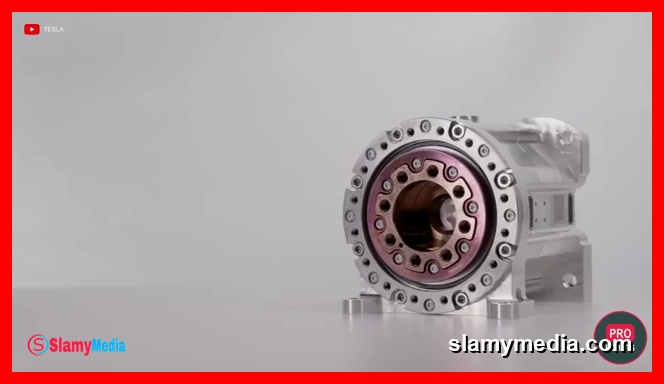
Because the actuators are, depending on what metric you're interested in, something like two to five times more performance than anything we could buy today. So in other words, these drives are incredibly compact and power dense. For example, the Tesla Optimus has a claimed payload of about 45 pounds, 20 kilograms. Atlas, on the other hand, can work 24-7 with loads that are 50% heavier. That's a massive gap, where the Tesla bot would be straining. The Boston Dynamics Robot maintains stability without its components wearing down. But even more importantly, manufacturing just two types of actuators instead of 15 is an unbelievable level of optimization for the production line. Just imagine what that means. The quality control team knows every single failure scenario for these two motors inside and out. The supply chain is radically simpler. Your entire inventory of spare parts could fit into a single cabinet, and here's the part the competitors really don't want to hear. By investing in the actuator, we drastically simplified the robot. Most of the structures are just simple, structural pieces connecting actuators together. The robot's body is basically just actuators connected by aluminum links. That's it. No complex gear boxes hidden inside custom housings, no 3D printed hydraulic channels snaking through the frame, just motors and metal. But the modularity of atlas goes even further. The left arm and the right arm, they're the exact same part. They aren't mirrored. They are identical. You can literally take an arm off the left side and slap it onto the right. Being able to stock a single arm that can be populated on the other side of the robot, and then being able to stock two types of motors that can be used in any one of the joints to take a limb that has been taken out of service and bring that back online. If a robot breaks its right arm at 2am, a night shift tech just grabs a spare arm off the shelf, bolts it on, and the robot is back to work. The whole operation takes less than five minutes, a few minutes, and it's back on the line. Compare that to the competition. When a Tesla Optimus prototype breaks a joint during testing, the whole robot is out of commission. Every joint is unique, so you can't just pop in a universal replacement. That right there is the difference between an engineering prototype and a real-world factory tool. However, these super-powerful motors create another problem, one that's lethal for electronics, massive heat. But the way the Boston Dynamics Engineer solved this is going to blow your mind. Take a close look at the surface of the robot's arms and legs. See those ridges? Those are cooling fins. Yeah, it's just simple passive cooling. No bulky internal fans, no liquid cooling loops, no over-engineered thermal management systems, just metal fins that dissipate heat, and as a bonus, keep human co-workers from getting burned if they touch the casing.
Scene 3 from Why Atlas Will Outwork Every Other Humanoid (Tesla Included)
It's simple, it's brilliant, even if it isn't exactly pretty. That right there is the difference between building a robot that looks cool in a demo video, and building a robot that won't send your factory workers to the ER. To be fair, Atlus does have a fan. But while most robots have them stuffed into every single joint, this thing gets by with just one. Care to guess where? We made a decision to try to go after passive cooling, which would again drastically simplify the robot. We don't have to have fans everywhere, so there's only one fan in the robot that ends in the head. And believe me, it's enough, even if it sounds impossible, and besides simplifying the build, this actually solves another massive headache. Not having fans in every joint makes the robot much quieter and gets rid of all those extra vents in the casing. Vents that are basically open invitations for factory dust to get inside and wreck the electronics. But is passive cooling really enough? The engineers give a firm, yes. This robot can operate in temperatures ranging from minus 4 degrees Fahrenheit to 104 degrees Fahrenheit, minus 20 degrees Celsius, to plus 40 degrees Celsius. Without freezing up or overheating, it's all about fighting for every single design element to make it as simple and functional as possible. That's why Atlus looks the way it does. It's not because someone drew a cool concept sketch. It's because every millimeter is the result of engineering constraints battling it out until they reached a perfect balance. The irony is that most people look at Atlus and see something weird. The Boston Dynamics Engineers look at it and see the only shape it could possibly have. But don't think for a second that everything here was simplified. The robot's head, the part handled by former Apple engineer James Cusio, turned into a total nightmare and is the one component they're still fine-tuning. There's a reason Cusio admitted this is the most complex computer he's ever worked on. Just think about it. You've got the processing power of a high-end desktop running real-time AI, reinforcement learning models, and 360 degrees spatial mapping. But it's sealed inside an IP67 waterproof housing and it's mounted on a moving neck. On top of a six-foot body that, let's be honest, is eventually going to fall over. Most companies show lots of videos of robots never falling. Three out-ears in the lab robots fall off the time. Here is a bit of brutal honesty you'll never hear from Tesla or figure. Robots fall down constantly. In the lab, during testing, during their first real-world deployments, that head has to survive every single one of those falls, or you're going to end up with a lot of $200,000 paper weights. The Atlas head has already gone through five iterations. Version 6 and 7 will probably be out before the product even ships. Why? Because perfection isn't good enough yet, and the devs at Boston Dynamics don't know how to quit.
Scene 4 from Why Atlas Will Outwork Every Other Humanoid (Tesla Included)
That's a level of engineering discipline you just won't find in companies that have barely revealed their first prototype and are already taking pre-orders. But despite the ruggedness, the design of the head is actually captivating. That signature light ring is a stroke of brilliance. It gets rid of the need for a face entirely, makes the design weirdly likable, and helps the robot communicate with humans. No creepy eyeballs or uncanny valley smiles here. Just a ring of light that says, I see you, I acknowledge you're there, and I'm on the job. And when someone enters its workspace, the robot can just give a little nod. Literally tilting its head a few degrees. Just to let the person know everything is fine. At one point, the robot almost lost its ability to move its head altogether, but the engineers realized it wasn't just about non-verbal communication. The main reason for a moving neck is total visibility. The robot needs to be able to look at what's right under its feet or directly over its head. After all, this robot is basically going to live at the factory, and it has to be self-sufficient. That requires maximum capability. The engineers had to sweat the details to provide that while keeping the design incredibly lean and optimized. Think about what working at an auto plant actually looks like. Atlas has to be able to haul heavy parts, screw in tiny bolts, and route flexible wiring, all at the same time. That's practically every kind of physical task rolled into one. If a robot can handle a car factory, it can handle anything life throws at it. This is where the engineering philosophy really clicks and proves itself. We're targeting a humanoid capability, but we're not targeting a humanoid form. Boston Dynamics is the first company to come out and say it plainly. The human body is not the pinnacle of design. It has plenty of limitations, and a robot shouldn't have to suffer from them. Whether you like the way the robot looks doesn't really matter. What matters is if it gets the job done. That's a pretty blunt reality check if you think about it. Half the robots at CES this year were from an engineering perspective, just mannequins with motors. They're nice to look at. They're impressive in a controlled demo, but the second you drop them onto a factory floor with real people, real heat, real dust, and 24-7 shifts, that pretty skin becomes a liability. Those sealed joints overheat and the hidden batteries die in two hours. Meanwhile, Atlas can swap its own battery in under three minutes. That makes it truly autonomous, 24-7. This robot was designed for the factory floor from day one. Its ugliness is its superpower. Every weird feature is an answer to a question the mannequin makers haven't even thought to ask yet. And there's another layer here. The BD engineers aren't designing for 2026. They're designing for 2028 and 2030 for the future.
Scene 5 from Why Atlas Will Outwork Every Other Humanoid (Tesla Included)
They're setting the trend and they aren't afraid of the critics. Atlas is incredibly practical, maybe even to a fault, but that's also its strength. The fact that the entire robot consists of separate, easily replaceable modules allows it to evolve indefinitely. New task, new solution. The engineers can just swap out a specific unit without having to reprogram the entire robot. Yeah, I think that's where the modularity of this design is really going to help us, right? Because we're not going to get 100% right. And hopefully the modularity will allow us to swap out parts of the robot, redesign pieces easily. This is the kind of mindset you get from a company that's been building robots for 30 years and has watched five generations of promises fail. This isn't optimism. This isn't marketing. This is engineering humility. The understanding that you don't know what you don't know. So you build a system that can adapt when reality throws you a curveball. Tesla says Optimus will cost $20,000. Boston Dynamics is betting Atlas will survive even if their assumptions are wrong. Which one would you actually put in your factory? But let's go back to where we started. Atlas looks weird. And now you know why. Every departure from the human form is an engineering solution to a problem that only shows up when you actually try to put a robot in a real factory. Chinese competitors, Unitry at $13,500, Agibot at $45,000, are flooding the market with cheaper robots. Tesla keeps promising $20,000 androids that still only do useful work in press releases. Figure and 1X are putting on beautiful demos in climate controlled labs. Meanwhile, Atlas is already sold out for all of 2026. Every single unit is spoken for. They're headed to Hyundai plants and Google DeepMind Research Labs. Here's the thing no one is saying out loud. This isn't a race for the cheapest robot. It's a race for the first robot that doesn't break. The cheapest car in the world has always existed, but the automotive industry was built by companies that made cars reliable enough to drive every single day. The exact same thing is about to happen in robotics. Maybe Optimus will hit that $20,000 price point. Maybe Unitry will sell a million units. But if those robots can't survive a night shift without human intervention, they aren't products. They're just demo units with a price tag. Boston Dynamics spent 30 years learning one thing. Robots fall down and they designed Atlas accordingly. From a head that can withstand a six foot drop, to arms that can be swapped out in minutes, and two motors the engineering team knows inside and out. It's not the prettiest robot, but it might just be the first one that actually works. And if you want to see more deep dives like this, you know what to do. By the way, if you had to start up a factory tomorrow, who would you put on the floor? Elon Musk's iPhone on legs or Boston Dynamics Tractor with AI?