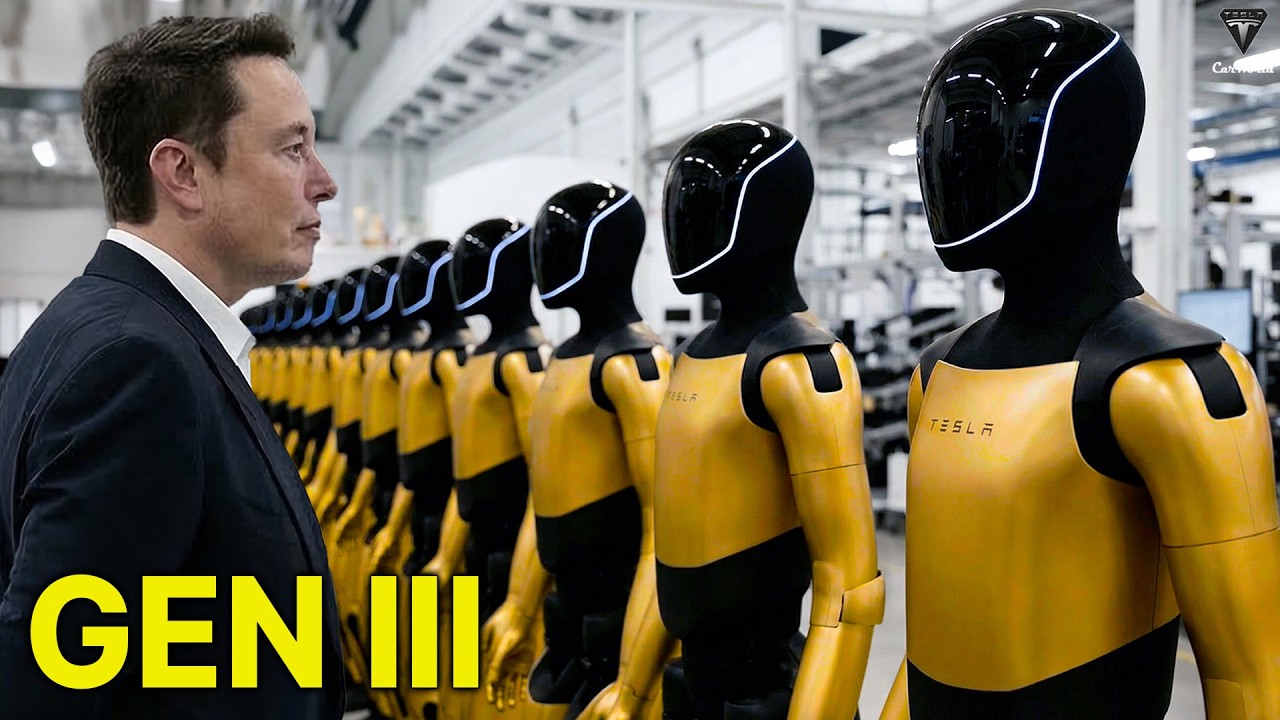
In the middle of the crowd is Optimus 3. And farther in the distance is Optimus 2.5. Yeah, after so many months, we finally know what Optimus 3 actually looks like. Just as Elon Musk said, this version looks like a human in a robot suit, and it's far more sophisticated than a traditional humanoid robot. Proof of that is the earlier video showing Optimus 3's hand. It made everyone stop and take a closer look because it looks exactly like a human hand wearing a glove. Some specs of Optimus 3 have also been revealed and they completely surpass version 2.5. Even though Optimus 3 is covered in black and honestly it looks a bit like a Terminator. That doesn't really matter if the design makes it easier for Tesla to manufacture. Now let's compare the two versions. What's better? What's worse? And what's still missing?


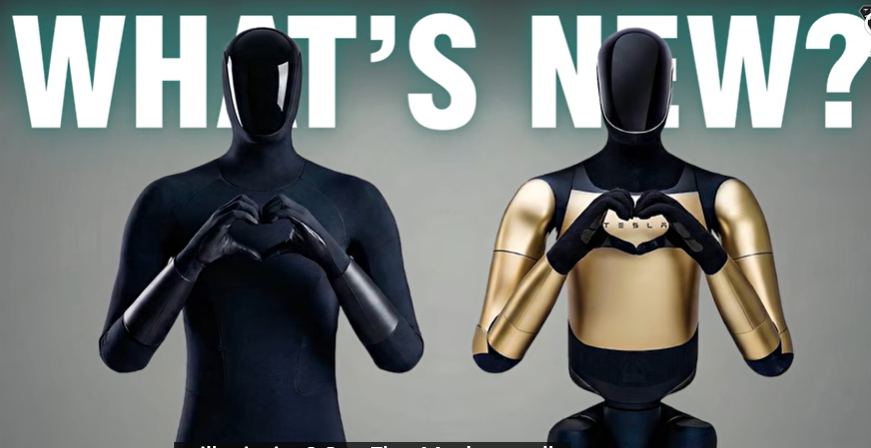
Can Elon Musk actually commercialize it by 2027 as promised? Let's get started. As you can see, this is a comparison image of Tesla's two Optimus versions. On the left is Optimus 2.5 with its exposed golden black metallic design, while on the right is Optimus 3, featuring a smooth all black outer shell, clearly showing a major step forward in turning humanoid robots from prototypes into products closer to mass production. You can see this design evolution even more clearly if you look back at Optimus in 2021. Okay, Optimus 2.5 still follows a typical prototype style. The upper body stands out with a glossy gold brushed metal surface combined with black, while the shoulders and joints are clearly exposed, giving it a strong but rough appearance with many visible cuts and seams. The robot's head features a bright white lead strip around the face visor with some internal structures slightly visible, emphasizing a high-tech feel, but not yet refined enough for home or close human environments. In contrast, Optimus 3 shifts to a minimalist streamlined design with a seamless black outer shell covering the entire body. almost like a full bodysuit that completely conceals the joints and mechanical components. The shoulders and hips are more rounded and its posture looks more natural, reducing the bulky feel while improving aesthetics and safety. Last year, Elon Musk admitted that mass-producing Optimus is a major challenge. So, Tesla needs a design that can be manufactured efficiently at scale. Even though Optimus 2.5 was already highly refined, it fundamentally wasn't suitable for production. So, we've made radical improvements to the design of Optimus um while increasing the functionality but making it actually possible to manufacture. Like I'd say Optimus 2 is almost impossible to manufacture, frankly. As you can see, Optimus is standing in a crowd and its size is basically comparable to a human. A few days ago, Elon Musk also confirmed on X that Optimus 3 is in the same league as Raptor 3. Raptor 3 is SpaceX's latest generation rocket engine used for Starship. Widely considered extremely advanced thanks to its simplified yet highly efficient design. What this means is that Elon is praising Optimus 3 as an engineering masterpiece on par with one of the most advanced rocket engines in the world today. That's very high praise from him since he rarely compares anything to Raptor 3. And [snorts] in the crowd image, you can spot some Tesla employees wearing Christmas sweaters, which suggests the photo was taken in December, meaning the design of Optimus 3 was likely finalized late last year. In fact, it may have been even earlier because back in September, Elon Musk said that Tesla had already completed the design of Optimus 3. >> We're finalizing the design of Optimus version 3. And uh that that really is going to be a very remarkable robot. Um it will have the essentially the manual dexterity of a human. So meaning a very complex hand. >> But what really makes us wonder is why haven't Tesla or Elon Musk officially unveiled Optimus 3 yet? They said it would launch in Q1 and now we're nearing the end of Q1, but nothing has happened. Could Tesla be preparing for a major event in April? Okay, beyond the design, Optimus' hand clearly holds some mysteries. Looking at the latest images, the hand no longer has that mechanical look. Instead, it has moved significantly closer to the biological structure of a human hand. The proportions of the fingers, the joint layout, and the overall shape make it look more like a mechanical replica of a human hand rather than a simple robotic tool. If earlier versions were like industrial grippers, this one is starting to resemble a musician's hand. flexible, precise, and full of expressive potential. Many sources suggest this hand has 22 degrees of freedom, a number that's not just impressive, but highly meaningful in terms of movement capability. Simply put, each degree of freedom is like an independent direction of motion for a joint. A finger that can only bend and straighten is like a door that only opens and closes. That's one degree of freedom. But as the number increases, the hand becomes more like a complex pulley system where even the smallest movements can be independently controlled. So 22 degrees of freedom means this hand can perform a wide range of complex actions that closely resemble human movement from powerful grips to extremely delicate manipulations. This evolution becomes even clearer when compared to earlier versions. Back in 2021, Optimus' hand was just a crude prototype with around four to five degrees of freedom, more like a basic gripper than a real hand. By 2023, Optimus 2 had improved to 11° of freedom. A significant leap, but still not enough for truly natural dexterity. And now, Optimus 3 has almost transformed, doubling that number and pushing it to the edge between machinery and biology. But why does this matter? Because in the world of humanoid robots, the hand isn't just another component. It's the ultimate test. A robot can walk and maintain balance. But if its hands are limited to simple gripping, then it's still just a visually impressive demonstration. On the other [snorts] hand, a sufficiently refined hand can transform a robot from a stage performer into a true working machine. Do do you need a robot to um you know take care of your kids or walk the dog or you know take care of elderly parents or something like that then [music] Optimus can do those things. Um so so that's very exciting. Um >> Elon Musk has pointed out that caring for an aging population is quickly becoming one of society's toughest issues. People are living longer, expenses are climbing, and even though families genuinely love and worry about their parents, work demands and everyday responsibilities often make it impossible to always be present. Because of this, many seniors find themselves living on their own without consistent support or the sense of safety they deserve. Against that backdrop, the Tesla CEO sees huge humanitarian potential in a robot built specifically for elder care. Optimus wouldn't just assist with movement, remind users to take medication, or detect falls. It could also offer companionship, hold conversations, and help older adults feel supported, secure, and far less alone in their daily lives. The brain of Optimus Gen 3 is not actually built from scratch for robotics. It is directly inherited from Tesla's FSD system. As announced at the recent Terrafab event, Elon Musk confirmed that Tesla bot 3 will use the AI5 chip with future generations expected to use AI6 potentially corresponding to Optimus 4 or Optimus 5. As Musk has previously mentioned, with these chips, Optimus will be able to localize itself in 3D space, recognize thousands of objects, and make near instant motion decisions. Instead of programming the robot through fixed scripts like traditional approaches, Tesla is taking a completely different direction, treating Optimus like a car with legs. This means the robot does not follow rigid commands, but instead operates on an end-to-end neural network capable of learning by observing humans through video, similar to how a child learns about the world. However, no matter how powerful the intelligence is, it becomes meaningless without enough energy to sustain it. 

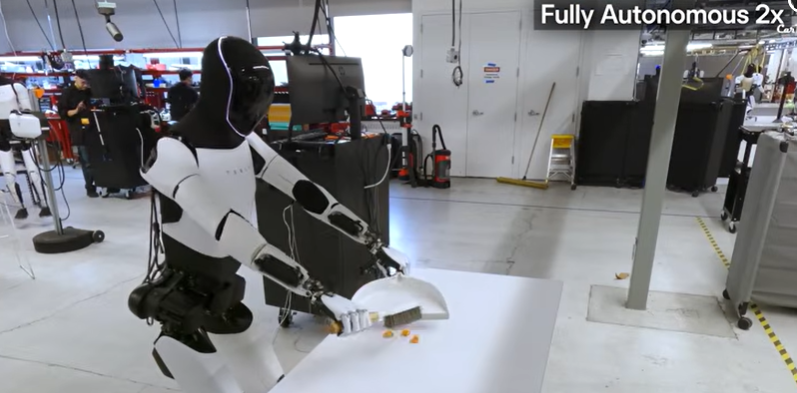
And this is where the battery challenge becomes much more complex than in electric vehicles. Even though Tesla has extensive experience with EV batteries, humanoid robots present a completely different problem. They must not only move but also continuously power dozens of joint motors simultaneously within an extremely limited space. It's like running while carrying a heavy backpack. The heavier the backpack, the more energy you expend, and the faster you get exhausted, robots face a similar consumption loop. A larger battery allows longer operation, but it also requires more energy just to maintain balance and movement, which in turn drains the battery even faster. This is an extremely delicate optimization problem. To address this, Tesla did not take the conventional route. Instead of using lowcost LFP batteries like many other companies, they reportedly partnered with LG Energy Solution and equipped Optimus Gen 3 with NMC Turner batteries, a type of battery with significantly higher energy density. Of course, this is based on leaked reports and has not been officially confirmed by Tesla, but it does appear quite plausible. NMC batteries are generally well suited for humanoid robots because they are more compact while storing more usable energy per unit of weight. In terms of specs, the Optimus Gen 3 battery pack has a capacity of around 3 kwatt hours, an increase from the previous generation's 2.3 kwatt hours. This upgrade allows the robot to operate continuously for about 7 hours, at least according to what Elon Musk has previously shared. And the ambition doesn't stop there. Musk even envisions a future where Optimus could work 24 hours a day like a non-stop worker, always ready to operate whenever needed. Even though Final Assembly still takes place in the US, the real backbone of the Optimus Gen 3 production story sits deep inside China's supply chain ecosystem. Elon Musk has acknowledged that around 50% to 63% of the components for the Gen 3 Tesla bot come from Chinese suppliers. And this isn't just a casual sourcing decision. It's driven by hard economics. Analysts at Morgan Stanley estimate that if Tesla tried to fully cut China out of the Optimus supply chain, the cost per unit could jump from roughly $46,000 all the way up to about $131,000. At the same time, Tesla's long-term target is to push the selling price down near $20,000, about the price of an entry-level car. Tapping into China's highly developed industrial robotics network, is what makes that kind of price compression even remotely realistic. Potentially cutting costs by as much as five times compared to a fully US-based build. On top of that, a clear optimist supply chain is starting to take shape. Similar to the ecosystem that powered the Apple iPhone, companies like Xia Jang Sanua are stepping in to handle thermal management systems. Ningbo Tuoku is focused on advanced actuator components and EverWin is supplying highly sensitive sensors. China today still dominates large-scale costefficient precision manufacturing, something that can't really be replicated overnight anywhere else. Elon Musk has also openly said that China is not just a major player, but effectively the main serious competitor in humanoid robotics right now. Firms like Unitry Robotics are already rolling out humanoid robots priced between $6,000 and $13,000. Still, Musk's argument is that price alone doesn't tell the full story. The real gap is capability. Many of these lowerc cost robots tend to be smaller, less powerful, and not yet built to handle sustained heavy duty work without overheating or breaking down. At the same time, bringing Optimus to market at scale with a target price of around $20,000 to $30,000 raises some real questions. Musk has said that Tesla might start selling these robots as early as 2027 after internal testing in 2026. But if there's one thing we've learned from complex tech projects, it's that timelines almost always slip. The challenge here is on a completely different level compared to cars. Vehicles operate in fairly structured environments and still rely on human oversight. But humanoid robots have to function on their own in unpredictable settings. They need to interact directly with people and handle countless unexpected situations in real time. That means the bar for safety, reliability, and consistency is much higher. A small issue in a car might just be annoying, but a mistake from a robot taking care of a child or an elderly person could be dangerous. Because of that, Tesla will have to test Optimus far more rigorously than anything it's built before. To get there, Optimus needs to pass some major realworld tests, especially when it comes to movement and dexterity. It has to be strong enough to carry heavy loads, but also precise enough to handle delicate objects without breaking them. That balance comes down to mechanical design, especially the hands and forearms, which Musk has admitted are the hardest parts to get right. Current versions like Optimus 2.5 still have limitations. Finger movements don't look fully natural yet and fine manipulation is still improving. So for Gen 3, the real challenge is proving it can reach something close to human level dexterity in everyday situations. Okay, next up is the intelligence and environmental awareness challenge. And this is where things get really tough. The robot can't just follow instructions. It needs to understand what's going on around it. That means recognizing objects, reading context, anticipating what people might do next, and making safe decisions on the fly. That's a huge leap for AI, especially in a home environment where nothing is ever perfectly organized or predictable. Tesla does have some advantage from its work on autopilot, but going from navigating roads to physically interacting with the real world is a completely different level of complexity. We believe that safety and reliability are just as important, if not more. Elon Musk has stressed that these robots need strict control at the hardware level. Meaning the AI can't just act on its own without limits. You need strong fail safes, constant system monitoring, and the ability to handle mistakes in a controlled safe way before Optimus ever hits the market. It has to prove it can run for thousands or even millions of hours without any major issues. Then there's the manufacturing challenge. Building a working prototype is one thing, but turning it into a mass market product is a whole different story. To be viable, it has to be produced at low cost with consistent quality and at massive scale. Musk has talked about making millions of units per year, but that would require Tesla to essentially rebuild its supply chain around highly specialized components like actuators, tactile sensors, and drive systems. And if even one part of that supply chain slows down, it could delay production or drive up costs, putting the entire planet at risk. Finally, there's the question of whether people will actually accept robots like this in their lives. And that's a bigger deal than it sounds. Even if the tech is ready, letting a robot into your home is a huge psychological step. People need to trust that it's safe, that it's genuinely helpful, and that it's easy to live with day-to-day. On top of that, concerns about job loss, privacy, or even AI getting out of hand aren't going anywhere they need to be addressed through smart design, clear communication, and the right safeguards. When you zoom out, what Elon Musk is trying to do with Optimus is incredibly ambitious but not unrealistic. Tesla brings some serious advantages to the table. From tight vertical integration to real experience building at scale, plus a strong AI foundation. That said, there's still a big gap between a working prototype and something you can massproduce and sell widely. If Tesla can solve the challenges around engineering, safety, manufacturing, and public trust, Optimus could end up being one of the defining products of this century. But if even one of those pieces doesn't come together, the timeline could slip, maybe by a lot. Either way, Optimus represents a major step toward taking robots out of controlled lab environments and putting them into the real world. It's a risky move, no question, but it also has the potential to completely reshape how we live and work. For now, that future is still taking shape. But with the way Tesla is blending advanced AI with efficient energy systems, Optimus Gen 3 is starting to feel less like a bold idea and more like something that could actually exist and operate alongside us in everyday life. So,

do you think robots like Optimus Gen 3 will truly become part of everyday life within the next decade? And what matters more to you, a lower price or higher capability when it comes to robots like Optimus? Drop a comment below. Optimus Gen the third of may still be on the horizon, but it's already pushing the boundaries of what robots can do. If you enjoyed this video, don't forget to hit like, subscribe, and turn on notifications [snorts] so you don't miss what's coming next. And we'll see you in the next one. Goodbye.