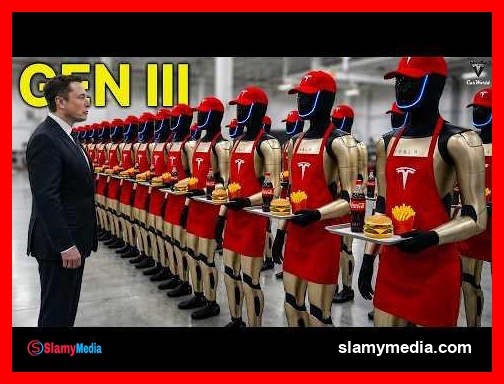
Optimus Gen 3 will be launched this April, and all its features, design, performance, and operational metrics will be nearly doubled compared to the current 2.5 version. Although it's encased in black, giving it a rather intimidating look. This design is said to be much easier to manufacture while significantly reducing the weight of the humanoid robot. Elon Musk has repeatedly emphasized that Optimus will eventually assist humans in all tedious tasks, and you can simply sit still while Optimus automatically performs those tasks. That's why the Tesla CEO believes that the final job will be optional. You can do it if you like, or give Optimus commands if you don't. Elon Musk's ambition is to bring millions of Optimus into large companies like Amazon, Walmart, or stores like McDonald's and Tesla Dinner, where Optimus 3 will act as a waiter. Currently, Tesla is carefully training Tesla bot to enable Optimus to perform more complex tasks. So what's coming to Optimus 3? How much more refined, upgraded, and efficient is it? Yeah, Elon Musk has ambitions to turn Optimus into a food delivery robot by 2026, delivering meals directly to cars at supercharger charging stations. While the latest third-generation Optimus might initially take on the role of serving popcorn as before, a rapid promotion isn't impossible. As we know, last week, Tesla released a photo of the Optimus team, around 210 people, along with what looks like an early Optimus 3 prototype. Tesla also regularly brings Optimus 2.5 to their dinner restaurants and lets it do some basic tasks like fetching popcorn, serving drinks, and chatting with customers. Many people think Optimus' all-black design looks quite scary because it's reminiscent of a terminator scenario from the movies we usually see. Yeah, we think this could be Gen 3, not 2.5 version, but clearly Optimus is being camouflaged, and we think that outer shell is significantly altering what's underneath. We'll soon see what's inside when Tesla shows more details when they're truly ready. So what makes Tesla Bot Gen 3 feasible for a waiter? Okay, the truth is that if we want a nearly perfect humanoid robot, it needs an extremely advanced engineering system inside. First, let's look at the hands. The part we've amazed more than once. In the world of robotics, hands are the dividing line between a clumsy industrial machine and a sophisticated service entity. Tesla's achievement of 22 degrees of freedom in just two years is a mechanical feat. A waiter doesn't just need to hold a tray. They need the sense of gravity to avoid breaking a wine glass. The dexterity to place a cutlery set correctly, and the stamina to repeat that action thousands of times a day. Competitioners might create hands that are dexterous but fragile, or strong but clumsy. Meanwhile, Tesla is on the right track by combining both approaches thanks to its self-manufacturing of specialized actuators. When Tesla engineers emphasize high-efficiency mass production, they are implicitly asserting that Optimus is not a display toy, but a cost-effective work tool. The vision of an Optimus waiter also requires the ability to move flexibly in complex human environments. If it moves too slowly and keeps customers waiting, it's almost useless, even with skillful hands. Therefore, speed of movement is also a major focus for Tesla in the final stages of upgrading the Optimus 3's hardware.
រូបភាពទាក់ទងនឹង Elon Musk "Tesla Bot Gen 3 Will Become Waiter", Optimus Complex Tasks Ready? (1)
In the Optimus 2.5 version, Optimus could move at speeds of nearly 2 meters per second, while the previous version could only move at less than 1 meter per second. So we can see the rapid optimization of Optimus' biomechanics for its legs. For Optimus 3 to be truly effective, it needs to reach walking speeds between 2.2 meters per second and 2.5 meters per second. Although Tesla hasn't officially disclosed anything regarding Gen 3 yet, a significant boost in mobility is definitely on the horizon. A service robot must be able to weave through tables, dodge obstacles in people, and move fluidly between the kitchen and the dining area. Since Optimus 2.5 already possesses a world-class dynamic balance system, we are highly confident that Optimus 3 will take that performance even further. This is crucial because a service environment is never a perfect straight line. It's full of variables and obstructions, increasing its walking speed to roughly 4 miles per hour ensures that Optimus won't be seen as an obstacle by customers. Instead, it can keep up with the fast-paced rhythm of a crowded restaurant. While we've seen Optimus serve drinks in food before, it was mostly stationary behind a counter. It will be fascinating to see Optimus carrying a tray through a crowd or delivering meals from the restaurant out to a customer's car. We think that not only Optimus, but any robot like Unitry, Boston Dynamic Atlas, or Figure 2 needs a system on a chip with a neural processing unit capable of performing at least 5 to 10 PETA operations, along with a powerful yet energy-efficient CPU and GPU. These robots also require a new breed of AI model. It has to process more than just language. It needs broad capabilities, rich training data, and constant internet connectivity for real-time updates. For Optimus, physical muscles and dexterity are merely the prerequisites. The secret sauce for Optimus to truly serve people is its communication brain. The integration of GROC voice, the conversational engine from XAI, is the key to breaking the barrier between man and machine. Imagine saying, hey Optimus, get me a glass of water, but not too cold. These aren't just rigid logical commands. They are requests that require deep contextual understanding. Optimus's natural language comprehension and intelligent responses make it more than just a tool for loading and unloading. It's a socially interactive entity. While its response speed still needs refinement, GROC's presence ensures the robot can think before acting, allowing it to handle communication situations intelligently and effectively. Previous videos showing Optimus interacting with crowds at events have demonstrated the importance of a talking robot. It truly captivates people. The story of the 8-inch OLED screen on Optimus 3's face is also worth discussing. Although Elon Musk hasn't confirmed this design, there are reports that Samsung has supplied 8-inch OLED screens to Tesla, and they will be used for Optimus. Okay, we all know Tesla prioritizes cost optimization, but the necessity of an expressive interface for a humanoid robot is undeniable, especially when Optimus is assigned a task. If it's a waiter, it certainly needs to be able to express emotions to customers, which is quite important.
រូបភាពទាក់ទងនឹង Elon Musk "Tesla Bot Gen 3 Will Become Waiter", Optimus Complex Tasks Ready? (2)
If Tesla decides to put Samsung's flexible display on the Optimus Gen 3, it would be a strategic move to humanize the technology, making the robot more friendly and approachable to the public, who are still hesitant about AI. In terms of practical operation, the water resistance and weather tolerance that Tesla engineers are quietly perfecting on Gen 3 is the solution to the environmental problem. Optimus Gen 3 will almost certainly be designed to withstand various weather conditions, which also means its water resistance will be at a certain level. Elon Musk has hinted that Optimus will be almost completely waterproof, and this certainly opens up opportunities for more complex tasks. Yeah, a restaurant service robot will inevitably be exposed to steam from the kitchen, spilled water from glasses, or even cleaning chemicals while cleaning. The polymer casing covering 70% of its body and the carefully sealed joints show that Tesla is preparing Optimus with a sufficiently robust protective suit to ensure it can work reliably in human environments without short circuits. While water resistant, don't expect Optimus Gen 3 to be able to swim in water or withstand heavy rain like those rugged IP68 rated devices. In reality, this isn't an industrial robot designed for harsh environments. However, its protection is more than enough to complete simple tasks. Additionally, Optimus 3 is expected to have more sensors across its hands, feet, and head. These sensors will be highly accurate, coupled with a series of 2D cameras on the front and back, and numerous cameras equipped on Optimus's head. Optimus will virtually mimic all human senses, allowing for visual, auditory, tactile, and more functions. Currently, only Tesla seems capable of meeting all these requirements. Finally, what makes Optimus Gen 3 truly a useful waiter is the Optimus Academy model we mentioned earlier. This is not just a training center, but a massive data ecosystem where the robot learns from millions of real world situations to improve its skills. Unlike the rigid programming approach of traditional robot manufacturers, Tesla is using AI to teach the robot how to live and work. When a robot in Giga, Texas learns how to skillfully carry a tray. That knowledge is immediately shared with thousands of other robots in Giga. Shanghai, or anywhere else globally through software updates. That's why Elon Musk's confident Optimus will eventually sell to almost everyone around the world. We're still wondering about one piece of information Elon Musk hasn't commented on whether Optimus will use Tesla's battery or one supplied by LG Energy Solutions. There have been reports suggesting Optimus will use Tesla's 4680 battery, but some articles indicate Tesla will use the more energy efficient NMC battery. To operate for longer periods, the robot needs a larger battery, but a heavier battery means the joint motors consume more power just to maintain balance and move the center of gravity. Therefore, if the report is accurate, Tesla's collaboration with LG Energy Solutions to equip the Optimus with NMC Turnery batteries is entirely convincing.
រូបភាពទាក់ទងនឹង Elon Musk "Tesla Bot Gen 3 Will Become Waiter", Optimus Complex Tasks Ready? (3)
Tesla is prioritizing weight and size reduction for the battery pack, allowing Optimus to maintain its slim profile and the necessary agility for a service robot in confined spaces. With a rumored capacity increase from 2.3 kilowatt hours to 3 kilowatt hours, this battery pack provides extremely high energy density, enabling the robot to operate continuously for approximately 7 to 8 hours, equivalent to a standard human work shift, with an impressive average power consumption of only around 430 watts. This figure demonstrates that the electro-mechanical conversion efficiency of next-generation actuators has reached maturity. Furthermore, choosing NMC allows Tesla to leverage its superior fast charging capabilities, supporting Elon Musk's vision of a 24-7 workforce through automated docking stations or even rapid hot-swap battery technology. OK, although NMC's material costs are higher and require more stringent thermal management systems, for a high-tech entity like Optimus Gen 3, this trade-off is entirely logical to ensure the robot is not just an intelligent machine, but also a durable tool ready to meet the most demanding requirements of modern service and industrial environments. You might not know this, but the chief engineer behind the Optimus project is actually Tesla's motor technology director, Constantinos Lescaras, who previously designed the primary drive motors for every Tesla model starting with the Model S, is now leading the development of Optimus' actuators. These components are arguably the most critical factor in determining whether Optimus becomes truly functional. A robot requires numerous actuators of varying sizes, however, in traditional robotics, most companies purchase these from third-party suppliers. These off-the-shelf parts are typically designed for general purposes, often resulting in robots that are either overweight or lack agility, drawing from their experience with the Model S and Model 3, where every millimeter and gram is optimized for peak energy efficiency, the Tesla team has moved away from using a one-size-fits-all motor. Instead, they've custom-designed specific actuators for every joint from high-torque units at the hips for heavy lifting to ultra-smooth units for the shoulders and high-speed ones for the wrists. This bespoke approach gives Optimus a remarkably stable technical architecture. According to our research, each humanoid robot requires between 28 and 40 actuators depending on the version. If Tesla produces 1 million robots a year, they will need up to 40 million actuators. This massive scale requires casting, copper winding, and quality control processes to be integrated directly into Tesla's vertical supply chain. Tesla is entering a decisive few weeks as the Optimus humanoid robot project moves into its final hardware and safety-testing phases. According to the latest updates from Elon Musk on X, the third-generation Optimus is now structurally complete and undergoing real-world operational trials at Tesla's manufacturing facilities. The core objective of this final tuning stage is to ensure that the actuators and the hands, which feature 22 degrees of freedom, achieve the mechanical durability necessary to operate continuously in harsh industrial environments.
រូបភាពទាក់ទងនឹង Elon Musk "Tesla Bot Gen 3 Will Become Waiter", Optimus Complex Tasks Ready? (4)
Tesla's primary focus right now is absolute safety standards, unlike traditional industrial robots that are confined to glass cages. Optimus is designed to work directly alongside humans. Consequently, its sensor systems and vision neural networks are undergoing rigorous testing to ensure the robot can detect obstacles in people with near zero latency. Energy efficiency tests have also shown promising results, with the ability to operate continuously for 7 to 8 hours on a single charge, equivalent to a standard human work shift. According to the plan, Tesla will officially launch a limited production line in the summer of 2026. The first units off the line will be deployed internally at the Gigatexis and Fremont factories to assist with vehicle assembly and battery component logistics. Deploying these robots in real-world settings this summer will not only help address labor shortages, but also generate a massive stream of data to train the Optimus Academy. This is a crucial stepping stone for Tesla to optimize its processes before moving to mass production next year. Realizing the vision of an era where robots replace humans in performing dangerous and repetitive tasks. Recently, US, Senators Tom Cotton and Chuck Schumer introduced a bipartisan bill to ban the government from using Chinese-made humanoid robots. This is a significant geopolitical move that creates a double-edged sword dynamic for Tesla and the Optimus project, market protection and strategic advantages. The most significant and direct benefit for Tesla is the protection of its domestic market. In the humanoid robotics sector, Chinese competitors like Unitry and Fourier Intelligence are advancing at breakneck speed, leveraging low production costs. This bill acts as a non-tariff trade barrier, effectively removing low-cost rivals from lucrative US government contracts, ranging from military logistics to public services. This creates a massive market vacuum that Tesla as the leading robotics technology firm in the US is the prime candidate to fill. Furthermore, the bill indirectly bolsters confidence in Tesla's data security. As the US government grows wary of potential backdoors or data leak risks from Chinese robots. Tesla can capitalize on this to establish a made-in-USA security standard. If Optimus proves to be safe and transparent regarding its software, consistent with how Tesla manages its domestic data supercomputers. It will become the default choice for government agencies and security sensitive private enterprises. In this way, Tesla isn't just selling robots, it's selling trust, an intangible yet incredibly valuable asset. However, this geopolitical blade cuts both ways. Tesla's greatest disadvantage lies in its global supply chain. As previously analyzed, the strength of Chinese robotics isn't just in the finished products, but in a highly developed ecosystem of components. From stepper motors to affordable sensors. If this bill triggers retaliatory measures or tightened export controls on components from China.
រូបភាពទាក់ទងនឹង Elon Musk "Tesla Bot Gen 3 Will Become Waiter", Optimus Complex Tasks Ready? (5)
Tesla could see the production costs for Optimus Skyrocket. While regionalizing the supply chain is a sustainable long-term solution. Establishing component factories in North America or Mexico will require a massive investment of both time and capital. A second risk is retaliation within the Chinese market. Tesla currently enjoys a symbiotic relationship with the Chinese government, evidenced by the rollout of FSD and the construction of the mega-factory. However, if the US bans Chinese robots, Beijing could easily reciprocate with similar bans on Optimus in their market of over a billion people, citing national security. This would cost Tesla access to one of the world's most potential consumer markets and hinder the AI's ability to learn from the diverse real world environments found in China. China currently possesses the world's most complete robotics industrial cluster, particularly in regions like Ningbo and Jeju-Jong, core components for Optimus, such as actuators. Thermal management systems and force sensors cannot be sourced elsewhere at a comparable scale and price. Partners like Jeju-Jong, Sanhua and Ningbo-2OPU are more than just suppliers. They have spent decades optimizing precision manufacturing for the automotive industry, which they are now applying to robotics. Tesla's reliance on China for 50% to 63% of its components demonstrates its use of economies of scale to drive production costs down from $131,000 to approximately $46,000. Without China, the dream of a $20,000 robot would remain nothing more than science fiction. How do you think Tesla will balance this dependency on Chinese manufacturing with the increasing political pressure to de-risk its supply chain? Secondly, there is the matter of speed and adaptability. In the tech era, time to market is a survival factor. Factories in China possess the capability to switch production lines and execute prototyping several times faster than their Western counterparts. For a product evolving as rapidly as Optimus, transitioning from Gen 2 to Gen 3 in a very short span, Tesla requires suppliers who can modify component designs almost instantaneously, while still maintaining high volume output. However, this reliance places Tesla in a high-stakes symbiotic position. On one hand, China provides the low-cost hardware necessary for Tesla to make robots accessible to the masses. On the other hand, Elon Musk has openly admitted that China is his most formidable competitor. When companies like Unitry or other Chinese domestic firms supply components to Tesla, they are simultaneously learning from Musk's rigorous technical standards and systems thinking, using that knowledge to refine their own competing products. So, do you think Optimus Gen 3 will actually be available for home use by 2027? What is the first chore you would want Optimus to do for you? That's it for today's deep dive into Optimus Gen 3. Let us know in the comments below. If you enjoyed this video, don't forget to hit the like button and subscribe for more tech updates. Thanks for watching, and we'll see you next time.