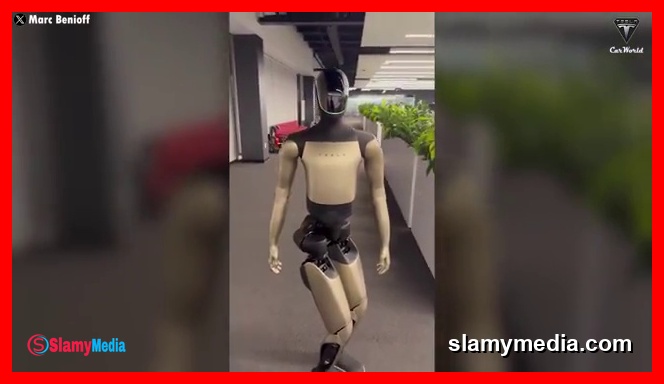
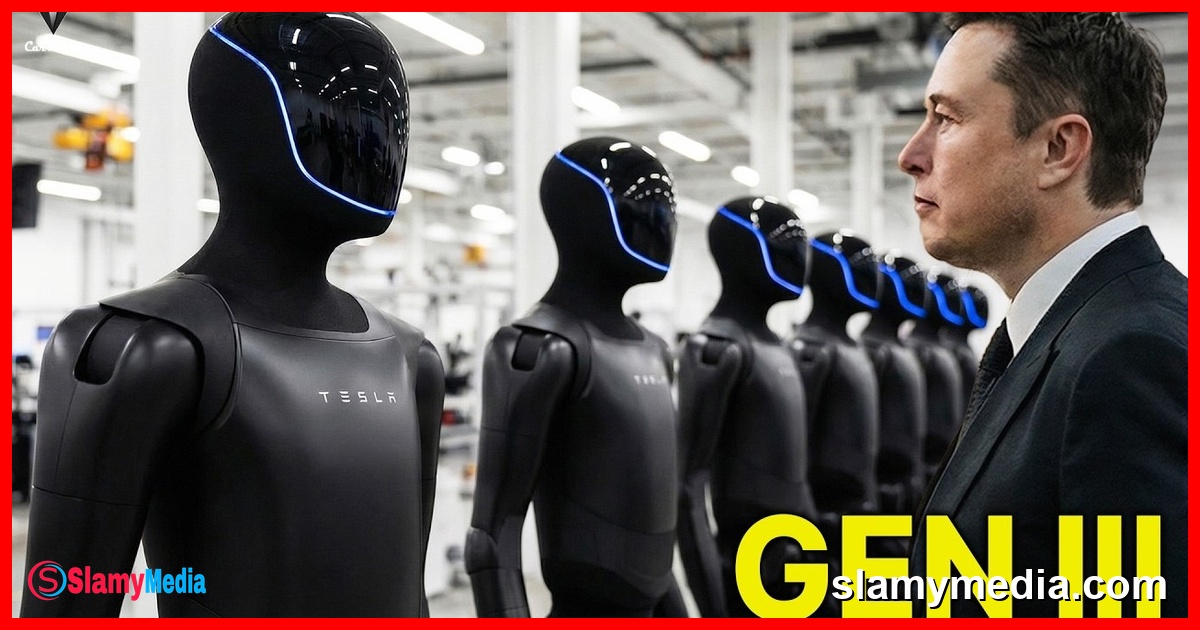
Tesla bought Gen III of May coming two versions, one in yellow like this and one in black like this, and it will be quite different from Optimus 2.5. The launch event could very well take place as early as this April. Yeah, Elon Musk has confirmed the progress of Optimus III, and it's in the final stage before being ready to appear in public. It will likely be similar to the Wii Robot event held in 2024, where people could interact and watch demonstrations by Optimus. Of course, after nearly two years, the engineering and design of Optimus III will be far more advanced than Optimus Gen II. You can see just how big the gap is by looking at the hands alone. So what's going on with Optimus III, and why is Elon so confident about this version recently? When asked why Optimus III wasn't launched in Q1 as expected, Elon Musk said on X Optimus III is walking around, but needs some finishing touches before it's ready to be shown. This aligns perfectly with what Angel Investor and Entrepreneur Jason Calacanus revealed. He said he saw Optimus III at a Tesla factory, and believes it could be the most groundbreaking technological product ever created in human history. And I saw Optimus III. I can tell you now, nobody will remember that Tesla ever made a car, and it is going to be the most transformative technology product ever made in the history of humanity. Yeah, we already know quite a lot about the standout features of this new version, even though it hasn't officially launched yet. Elon Musk and Tesla's engineers have recently emphasized that Optimus Gen III is getting closer to human form and functionality. Even though we don't really want to repeat ourselves since we've mentioned it many times before, every time we look at Optimus III's hands, we can't help but wonder. How were they able to create hands like that in less than two years? They actually managed to build a 22 degree of freedom hand in just two years, one that really doesn't fall short of a human hand. That's something most competitors haven't been able to pull off. It'll let Optimus handle a wide range of tasks with incredible precision. Tesla definitely has the right to be proud, because the hand is one of the toughest engineering challenges in robotics today. It's kind of funny. We're pretty sure Elon Musk has pointed this out at least 10 times in talks and podcasts. People often say it's half the engineering problem, but honestly, we think it's even more than that. You can build a dexterous hand, or you can build a strong, durable one, but making a hand that's both dexterous and tough is really hard. We've seen highly dexterous robot hands before, but they'd probably break down under everyday use, beyond the hand. Optimus III's movement capabilities and speed are also worth paying attention to. Looking at footage of Optimus 2.5 from a video posted in December, it showed the Tesla bot could run at an estimated speed of up to 6.8 miles per hour, with running form about 90% similar to a human. According to Dr. Scott Walter, what's even more impressive is that even as version 2.5, each stride looked very natural, and there were moments when both feet were almost completely off the ground. That's actually
Scene 1 from Elon Musks Tesla Bot Gen 3 April Launch Event Coming!
pretty similar to how human biomechanics work when running. So what does a running speed of around 6.8 miles per hour really mean if you break it down? That suggests a walking speed somewhere around 4 to 4.5 miles per hour, or roughly 1.8 to 2.0 meters per second. Typically, a humanoid robot only needs to move at about 2.5 miles per hour to be useful around a house or factory. So if Optimus 2.5 is already hitting 4 miles per hour, it's not surprising that Optimus III could go even faster. Now, everyone probably already knows this, but it's still worth repeating. Tesla's Optimus Gen III will have GROC voice, and in fact, it's already been officially integrated since mid 2025 in version 2.5. Elon Musk has also confirmed this when asked whether Optimus would use GROC as a voice assistant. GROC, the advanced AI model from XAI, acts as the conversational brain for Optimus 5.3, enabling much more natural interactions. Instead of just following rigid commands, the robot can now understand and handle everyday conversations intelligently. From something like, grab me a glass of water and tidy up the table. To more complex tasks that require contextual reasoning. Sure, response speed might still need some improvement to feel perfectly smooth, but it's definitely a must-have feature. Honestly, a lot of people wouldn't enjoy a robot that can do everything but can't hold a conversation. It'd feel pretty dull. On top of that, some tech outlets are reporting that Samsung display is expected to supply 8-inch OLED panels to Tesla starting in 2027. There's speculation that these could be used as a facial display for Optimus Gen III since its face has a hemispherical human-like shape that works well with flexible OLED, thin, lightweight, power-efficient, and bendable, which is hard to achieve with standard LCDs. This kind of display could show emotional expressions, communication cues, or just make the robot feel more approachable to humans. That said, this is all industry speculation. There's been no official confirmation from Tesla. Honestly, we don't think it'll happen, mainly because it would drive up the cost of Optimus, but at the same time, it does feel kind of necessary, right? So what do you think about Optimus 3 having a display on its face? Is it actually necessary? Like we mentioned in a previous episode, Optimus Gen III will almost certainly be designed to handle a range of weather conditions, which also means some level of water resistance. Elon Musk has hinted that the robot will more or less have this capability. Various reports and analysis from Tesla engineers suggest Gen III will feature better sealed joints, a polymer shell covering around 70% of the body, and improved sealing in the hands to handle rain, steam, soap, and general indoor humidity. Of course, that doesn't mean it's fully waterproof. You wouldn't be able to submerge it or use it continuously in heavy rain like an IP68 rated device. Optimus Gen III isn't meant to be a full-on all-weather industrial robot,
Scene 2 from Elon Musks Tesla Bot Gen 3 April Launch Event Coming!
but it should be water resistant enough to function as a practical home assistant. Even though everyone knows training humanoid robots requires massive amounts of data and complex real-world environments. Tesla's Optimus Academy is the breakthrough solution that Elon Musk has hinted at, aimed at turning Optimus Gen III into a truly intelligent assistant. This isn't a traditional school, but more like a large-scale real-world academy where tens of thousands of humanoid robots learn, practice, and improve their skills through self-play and physical environments, tightly combined with ultra-realistic simulation. According to Elon Musk, Tesla plans to deploy at least 10,000 robots, potentially scaling up to 20,000 or even 30,000, constantly testing different tasks, from household chores like cleaning, cooking, and elderly care to more complex industrial work. The goal is to create a closed learning loop where robots don't just follow commands, but also explore, make mistakes, and optimize their behavior independently. Add its core. Optimus Academy combines two main learning approaches, learning from humans and learning from instructional videos. In the early stages, the simplest way to train Optimus is through human demonstration. The Optimus Lab is located in a glass-walled building at Tesla's engineering campus in Austin. Inside, dozens of workers wear motion capture suits equipped with five cameras mounted on their helmets, along with a heavy backpack, working eight-hour shifts to train the robot. Their job is to repeatedly perform hundreds of everyday actions lifting a glass of water, wiping tables, opening curtains, walking, running, dancing, or even simple industrial tasks. Every movement is carefully recorded to build imitation learning data sets for Optimus. This video data is then fed into end-to-end neural networks, allowing the robot to learn how to move, grasp, and interact with the physical world more naturally. This marks an important transition for Tesla. In the past, the company relied heavily on teleoperation to train robots, but that approach is slow and difficult to scale. Even small data collection tasks can take weeks, and Tesla reportedly paid around $48 per hour to workers wearing motion capture suits to generate training data for Optimus. However, this is just the initial phase. By the time Optimus is fully commercialized, it should be able to learn new tasks on its own without requiring users to train it. At that point, Optimus will be capable of learning from videos on the internet, though those videos will need to be curated by Tesla. For example, it could watch tutorials on how to use a microwave, stir a pot, clean floors, or even perform kung fu movements, then imitate and adapt them to its mechanical body. Tesla has already made significant progress in transferring knowledge from both third person and first person video perspectives to robots, allowing Optimus to rapidly acquire skills without step-by-step programming. This approach is powered by a strong sim-to-real transfer pipeline.
Scene 3 from Elon Musks Tesla Bot Gen 3 April Launch Event Coming!
Tesla has developed a highly accurate reality generator, similar to what it uses for self-driving cars, to create millions of virtual robots in simulated environments. In simulation, robots can safely test billions of dangerous or rare scenarios without any real-world damage. Then, data from tens of thousands of real robots in Optimus Academy is used to close the Sim-to-real gap fine-tuning models, so behavior and simulation closely matches reality. The result is a system where robots learn dramatically faster than relying on limited real-world data alone, while also reducing training risks and costs. There's no denying that Elon Musk, once again delaying the Optimus launch timeline, has been disappointing for those who were expecting a major presentation before the end of March. A milestone Tesla had previously hinted at in its Q4 2025 earnings report. We'll probably unveil Optimus 3 in a few months, and I think it's going to be quite surprising to people. It's an incredibly capable robot. Although Elon Musk hasn't given a specific launch date, the phrase final polishing stages suggest that a major unveiling event could be just around the corner, possibly sometime in April. Tesla is known for holding its major demos to extremely high standards, and after the big leap in control and dexterity we saw from Gen 1 to Gen 2, expectations for Gen 3 are sky high. This week, Optimus has even been spotted working at the Tesla diner in Los Angeles, moving around and performing basic tasks for onlookers. A lot of humanoid robotics companies today have already demonstrated robots operating in both industrial and home environments from warehouses and factories to kitchens and living rooms, but safety is still a big, unresolved issue, especially in household settings. So the question is, how serious are the safety challenges for humanoid robots? When people ask when we'll see humanoid robots in homes, we think the better question is, when are they safe, not when they're capable enough or cheap enough. If they're not safe, they won't be in homes, because no one's going to buy one. That's why Elon Musk has repeatedly emphasized the importance of making Optimus 3 a truly safe robot. Now, we can tolerate less safe robots and factories because we're used to managing dangerous equipment with safety zones, lockouts, and strict procedures, but at home it's a whole different story. You could try saying, hey Optimus, only operate in this room when no one else is inside, which reduces risk since walls and closed doors basically act as safety barriers, but making sure no pets, kids, or someone else accidentally walks in. That's almost impossible. The safety of Optimus Gen 3 is one of the top priorities that both Tesla and Elon Musk consistently emphasize. Musk has repeatedly stated that humanoid robots must reach a higher level of safety and security than any product Tesla has ever built,
Scene 4 from Elon Musks Tesla Bot Gen 3 April Launch Event Coming!
because Optimus isn't just a moving machine, but an AI system that can see, hear, think, and act directly in human living and working environments. The safety risks with Optimus are significantly greater than with self-driving cars or typical smart devices. A software bug or cyber attack could lead to real world physical consequences moving at the wrong time, applying incorrect force when grasping objects or providing inappropriate assistance to elderly users. That's why Tesla is likely to implement multiple layers of protection such as military grade data encryption, real-time system monitoring, automatic emergency shutdown mechanisms when anomalies are detected, and secure remote control systems that allow humans to intervene instantly. On top of that, since Optimus continuously learns from real-world data and receives over-the-air updates, Tesla tightly controls training data sources, learning processes, and software updates to prevent unintended behavior. Initially, the robot will be deployed internally within Tesla factories to gather data and validate safety before expanding into consumer environments. Will humanoid robots ever reach human level dexterity? Yes, they will. We just don't know exactly when. Once they become useful, they'll keep improving over time. We might not see truly superior dexterity across a wide range of tasks until sometime in the mid-2030. That said, it's easy to fall into the trap of thinking robots need the exact same sensory systems as humans, but that might not be true. They could function perfectly well with lower-level sensors, or even without certain types of sensing altogether, much like how humans adapt to reduced abilities over time. Right now, there's a serious labor shortage across a lot of industries. It'll take time before there are enough robots to make a meaningful impact, mainly because these are jobs people don't really want to do. Robots will still be limited by their capabilities. They won't be able to do everything. What that means is more people may shift into other roles. For example, if you had to choose between working in an Amazon warehouse or a nursing home and both are understaffed robots could start taking over the warehouse jobs, that would free up more people to work in nursing homes, where tasks might still be too complex for humanoid robots. When it comes to Optimus, we see two major concerns so far. First, while there has definitely been progress, most of it hasn't been demonstrated through detailed, real-world tasks. Tesla has released very few demos, and there are still big gaps. With such an impressive robotic hand, why not show it doing something concrete, like peeling an egg, washing dishes, or even just tearing a piece of paper? That's something we're genuinely skeptical about, because we don't want to assume that everything Tesla has shown so far is just low-value demos. The second concern is why haven't we really seen Optimus doing actual work inside factories? That's a bit confusing. Sure, we've seen it carry battery trays and do some basic sorting, but that's about it. Elon Musk has said that this year, most Optimus units will be used internally and deployed in Tesla factories. So the real question is,
Scene 5 from Elon Musks Tesla Bot Gen 3 April Launch Event Coming!
what exactly will Optimus be doing on those production lines? Other humanoid robots like Atlas from Boston Dynamics, Figure 02, and several Chinese robots have already demonstrated the ability to handle large automotive metal parts and factory settings. Meanwhile, Tesla has countless factories and production lines, with plenty of stations to test these capabilities, so why haven't we seen any real demo videos? When we look at humanoid robots like Optimus, we're clearly facing a double-edged sword. On one hand, the technology promises to eliminate dirty, dangerous, and repetitive work. On the other, it raises concerns that millions of human jobs could be replaced. This isn't the first time humanity has faced that fear. From the Jakarta loom in the 18th century to the assembly lines pioneered by Henry Ford, and later waves of industrial automation. History shows that every major technological leap comes with deep labor shifts. There are currently two opposing viewpoints about the speed and scale of impact. One side believes robots will replace jobs exponentially almost overnight causing massive unemployment. I don't agree with that. In reality, the world is already facing serious labor shortages across many sectors from logistics and manufacturing to health care and services. Deploying humanoid robots at scale won't happen as quickly as people think. Even if Tesla starts producing Optimus Gen 3 by summer 2026, it will still take years to reach volumes large enough to create a noticeable impact across the economy. On top of that, robots have clear limitations. They'll excel at repetitive, physically demanding, and dangerous tasks that humans don't want to do, but they'll struggle with jobs that require fine dexterity. Ethical judgment. Emotional intelligence. Or complex human interaction. For example, if robots start taking over roles in Amazon warehouses where labor shortages are severe, it could free up human workers to move into other areas that desperately need people, like elderly care, education, or health care. These roles often require empathy, adaptability, and the ability to handle unpredictable situations. Things humanoid robots still can't fully replace. In the end, humanoid robots aren't necessarily a threat that will replace all human labor. Instead, they could become powerful tools that complement human work and boost productivity. The real challenge isn't the technology itself. It's how we prepare our policies, education systems, and mindset to adapt to this shift. So, do you think Tesla Optimus will have a positive or negative impact on society in the long term? Drop your thoughts in the comments below. If you enjoyed the video, please give it a like, subscribe to the channel, and hit the notification bell so you don't miss future updates on Tesla, Optimus, and cutting edge technology. Thank you so much for watching until the end. We really appreciate your support. See you in the next video. Stay curious and have an amazing day.