

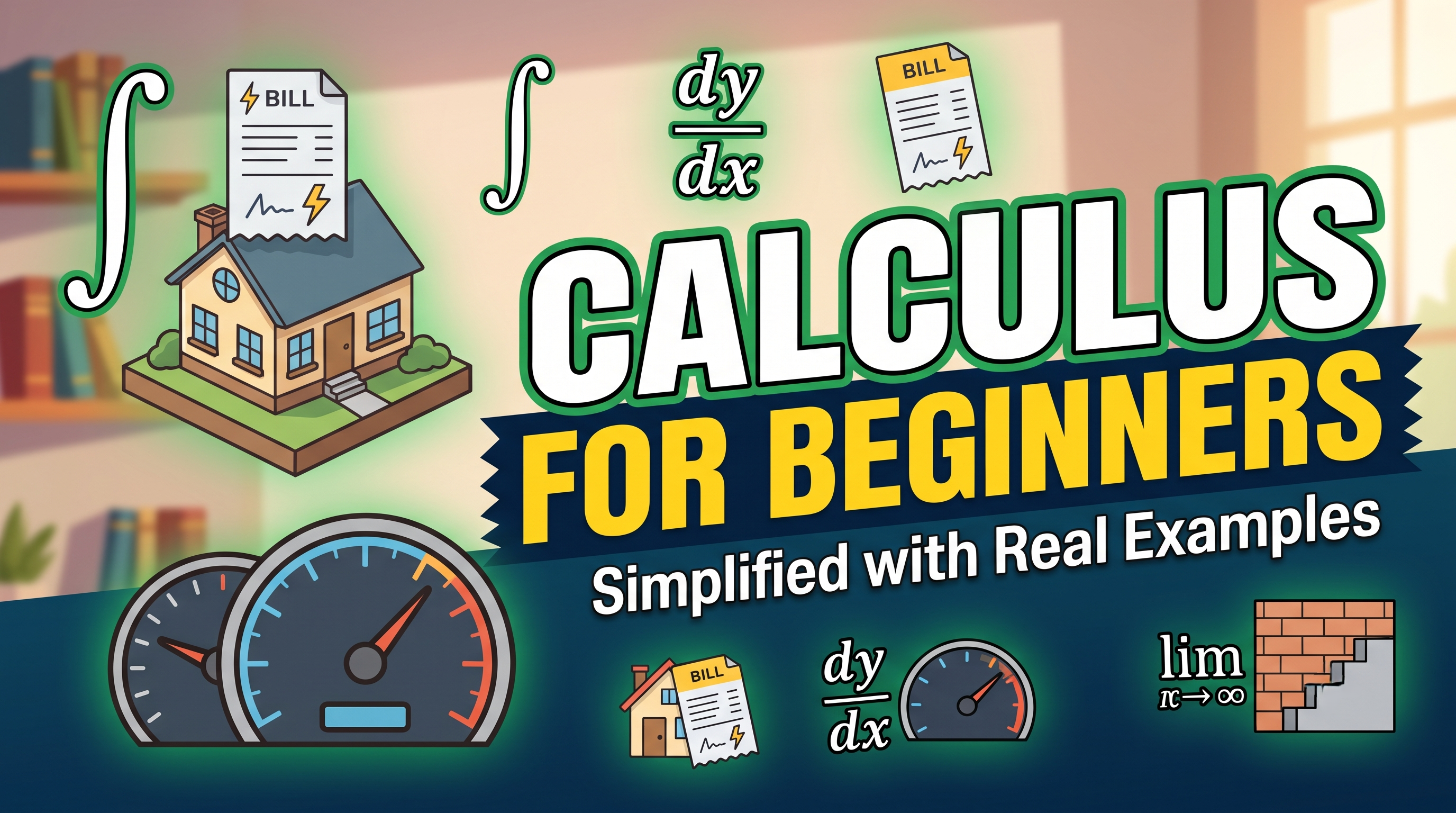
Calculus, Explained Like You're Learning It From a Friend, Not a Textbook
Every idea in calculus — limits, derivatives, integrals, series — started as a way to answer one honest question: how does something change? Each chapter below pairs a plain-English analogy with a real-world example and a quick quiz so you can check yourself as you go.
Most people quit calculus because they meet the symbols before they meet the ideas. Flip that order and calculus turns out to be one of the most intuitive branches of math — it's really just a formal language for describing change and accumulation. Read this once, try every quiz, and you'll be able to explain each concept to a friend without writing a single equation.
Limits: Getting Infinitely Close
Picture yourself walking toward a wall. You take a step, then half a step, then a quarter step, then an eighth — each step closing half the remaining distance. You never technically touch the wall, but there's no doubt about where you're headed. That destination — the value your steps are homing in on — is a limit.
Formally, a limit describes the value a function approaches as its input gets closer and closer to some point, even if it never quite reaches it. Limits matter because a huge number of quantities in the real world can't be measured directly at a single instant — you have to sneak up on them by looking at smaller and smaller windows around that instant.
Self-driving cars and braking distance. An autonomous vehicle's collision-avoidance system doesn't just know "the car is 20 meters away" — it needs to know how that distance is changing as time shrinks toward the present moment. Engineers use limits to define exactly what "current speed" means at an instant, even though nothing can truly be measured over zero time. Every time your phone's maps app estimates your live speed, it's leaning on the same idea.
Limits also resolve famous paradoxes. The ancient Greek philosopher Zeno argued motion was impossible, since crossing a room requires first crossing half of it, then half of what remains, forever. Calculus shows infinitely many steps can still add up to a finite, ordinary distance — exactly what a limit captures.
Q1. As you take smaller and smaller steps toward a wall without ever touching it, what does calculus call the value you're approaching?
Derivatives: Speed at a Single Instant
Imagine your mother checking the GPS on a road trip. At 2:00 p.m. you're 50 miles from home; at 3:00 p.m. you're 110 miles away. That's an average speed of 60 mph. But what if someone asks how fast you were going at exactly 2:30? You need to shrink the time window smaller and smaller, down to a single frozen instant.
That's a derivative: the result of shrinking the time interval down to zero. It tells you the instantaneous rate of change of one quantity with respect to another.
The roller-coaster mental model
Sketch a roller coaster's track. On a flat stretch the derivative is zero. On a steep climb it's large and positive. On the plunge down it's large and negative. The derivative is simply "how steep is the hill, exactly at this spot."
Marginal cost in business. If a factory's total cost depends on how many units it makes, the derivative of that cost function is the marginal cost — how much one more unit costs right now. Companies use this to decide whether ramping up output is still profitable. Your car's speedometer performs the same math mechanically, live.
Q2. On a roller coaster sketch, what does a flat section of track tell you about the derivative there?
Partial Derivatives: One Knob at a Time
Real quantities rarely depend on just one thing. Imagine a speaker with two knobs — one for volume, one for bass — and both affect the sound. A partial derivative asks: "If I nudge only the volume knob and freeze the bass knob, how does the sound change?" You then repeat the question for the bass knob alone, always holding every other variable constant.
Weather forecasting & machine learning. Temperature depends on latitude, altitude, and time all at once — meteorologists isolate "how temperature changes with altitude, location fixed" to build storm models. Neural networks "learn" the same way: computing partial derivatives of an error function with respect to thousands of individual weights, one at a time, to know which knob to turn.
Q3. When finding a partial derivative with respect to one variable, what do you do with the other variables?
Integrals: Adding Infinitely Many Tiny Pieces
Where a derivative zooms into a single instant, an integral zooms out to total up an entire changing process. Picture painting an oddly shaped wall with a very thin brush, in vertical strips. Integration answers: how much paint does the whole wall need?
The technique: slice the shape into infinitely many, infinitely thin rectangles, and add them all up. The thinner and more numerous the slices, the more accurate the total.
Your monthly electricity bill. Power usage fluctuates constantly — a spike from the oven, a dip overnight. Utility companies integrate a constantly changing wattage reading into total kilowatt-hours used over the month. The same logic finds total distance traveled when speed keeps changing, or total rainfall when the rate varies minute to minute.
Q4. What is an integral, in plain terms?
Double and Triple Integrals: Going 2D and 3D
A single integral slices in one direction, like cutting a chocolate bar into thin strips. A double integral handles a flat sheet — slicing across, then down, adding rows of rows. A triple integral handles a full 3D solid, like a birthday cake: chop it into tiny cubes going across, forward, and up, then add every cube together.
Medical imaging. A CT or MRI scan reconstructs a 3D image from thousands of 2D slices; triple integrals calculate volumes, densities, and mass distributions inside the body. Urban planners use double integrals over a city map to find total population within an irregular district given a density function that varies block by block.
Q5. Which is the best analogy for a triple integral?
Line and Surface Integrals: Curvy Paths, Bumpy Shapes
What if the path you're summing along is curvy and wiggly, or the surface is bumpy like a mountain range? A line integral imagines an ant walking a bendy wire — some parts hot, some sticky — and adds up everything it experiences along the way. A surface integral does the same over a curved surface, like a blanket draped over pillows.
The shortcut: Stokes' and Divergence Theorems
Remarkably, instead of grinding through every point of a wiggly surface, you can sometimes get the same answer by examining only its edge — like judging a cake's frosting by measuring just the rim.
Electricity and magnetism. Maxwell's equations — behind every electric motor, radio wave, and MRI machine — are written using line and surface integrals. Engineers use the Divergence Theorem to relate an electric field flowing through a closed surface to the charge sealed inside it, without measuring the field everywhere.
Q6. What clever shortcut can replace a full surface integral calculation?
Common Integration Techniques
U-substitution
Think of a present wrapped inside another present. U-substitution unwraps the layers until you reach a simple gift you already know how to solve, then rewraps everything on the way out — perfect for "a function wearing a costume."
Integration by parts
Split an impossible chore into two smaller, manageable pieces and trade — the go-to move whenever two different functions are multiplied together.
Trigonometric identities
When sines and cosines tangle together, identities transform the expression into an equivalent, simpler shape.
Signal processing. Audio engineers compressing an MP3, or radio engineers tuning a station, are constantly integrating sine-and-cosine-based functions — sound and radio waves are literally trig functions. These techniques make those integrals solvable quickly, even inside a tiny radio chip.
Q7. U-substitution is most useful when an integral looks like...
Series: Adding Numbers Forever
A sequence is a list of numbers following a pattern. A series is what happens when you add that list up. The central question: if you keep adding forever, do you settle on a finite number, or fly off toward infinity?
Picture a chocolate bar: eat half, then half of what's left, then half of that, forever. The series 1 + 1/2 + 1/4 + 1/8 + ⋯ converges to exactly 2. A series that settles on a finite total is convergent; one like 1 + 2 + 3 + 4 + ⋯ that keeps growing is divergent. A Taylor series rebuilds almost any smooth function from an infinite sum of simple polynomial terms.
How your calculator computes sin(x). It doesn't store every possible value — it computes a Taylor series, a handful of polynomial terms added together, astonishingly close to the true value in milliseconds. Compound interest in a retirement account is itself a convergent series, adding ever-smaller interest payments over ever-shorter periods.
Q8. Does 1 + 1/2 + 1/4 + 1/8 + ⋯ forever converge to a finite number, or diverge to infinity?
Infinity: Not a Number, a Direction
Infinity isn't a giant number — it's more like a direction than a destination, a road with no final mile marker. Here's the surprising part: not all infinities are the same size. The counting numbers 1, 2, 3, … form a countable infinity. The decimal numbers between 0 and 1 form a strictly bigger, uncountable infinity — between any two decimals, no matter how close, another one always fits between them.
Digital audio and image compression. A real sound wave has uncountably infinite possible values at every instant, but a digital recording can only sample a countable, finite set of points. This gap is exactly why compression always loses some information, and why higher sample rates sound closer to the original.
Q9. Which is a bigger infinity: the counting numbers 1, 2, 3, ... or the decimals between 0 and 1?
Differentiation Rules: The Shortcuts
Calculating a derivative from first principles every time would be like forging a new hammer for every nail. Instead, mathematicians discovered shortcut rules.
Population growth and epidemiology. Bacterial growth and early-stage epidemic spread are modeled with functions built on ex, because a quantity growing in proportion to its own size has a derivative that mirrors itself.
Q10. Which function is its own derivative?
The Fundamental Theorem of Calculus
Derivatives and integrals look unrelated — one zooms into an instant, the other adds up a whole process. The Fundamental Theorem reveals they are perfect opposites, the way addition undoes subtraction: derivatives undo integrals, and integrals undo derivatives.
Everything in calculus rests on this one universe-revealing truth.
Rocket trajectory planning. Engineers know a rocket's acceleration from its engine specs. To find its position over time, the Fundamental Theorem lets them move directly between "how fast is it changing" and "how much has accumulated" — exactly how mission planners calculate fuel burn and landing windows.
Q11. According to the Fundamental Theorem of Calculus, how are derivatives and integrals related?
Cheat Sheet: Concepts at a Glance
| Concept | Plain-English idea | Everyday example |
|---|---|---|
| Limit | What a value approaches, without necessarily touching it | Live speed shown on a maps app |
| Derivative | Rate of change at one exact instant | Car speedometer |
| Partial derivative | Rate of change from one variable, others held fixed | Neural network training |
| Integral | Total accumulated from infinitely many tiny pieces | Monthly electricity bill |
| Double/triple integral | Accumulation over a flat area or 3D volume | CT scan volume rendering |
| Line/surface integral | Accumulation along a curved path or bumpy surface | Maxwell's equations in electronics |
| Series | An infinite sum that may settle on a finite total | Calculator's sin(x) function |
| Fundamental Theorem | Derivatives and integrals undo each other | Rocket trajectory planning |
Frequently Asked Questions
Is calculus actually used in real jobs, or just in exams?
It's used constantly — in engineering, economics, medicine, machine learning, architecture, and finance. Anywhere a quantity changes over time or space, calculus models and predicts it.
What's the easiest way to start learning calculus from scratch?
Start with limits and derivatives using visual, physical examples — speed, slope, motion — before touching algebraic notation. Once the intuition is solid, the symbols become shorthand for ideas you already understand.
Do I need to memorize every integration technique?
No. Most students learn to recognize the "shape" of a problem and build fluency through practice rather than memorization alone.
What's the single most important idea in calculus?
The Fundamental Theorem of Calculus — it shows derivatives and integrals are two sides of the same coin, making the whole subject one unified toolkit.

Conversations (0)